
Every online game has a moment where a player clicks “I Agree” or “Continue” and, in theory, agrees to your terms. Your EULA, your terms of service, your refund policy, and the arbitration clause your lawyer fought to include all rest on that one click.
Here is the uncomfortable part: a lot of those clicks do not actually create a contract. Courts have spent the last few years drawing a hard line, and a surprising number of game and app sign-up screens land on the wrong side of it. If a player disputes a charge, breaks your rules, or sues, the first thing their lawyer attacks is whether your terms ever bound them at all.
So let’s answer the real question: when are your game’s terms of service actually enforceable?
The two things courts require
Enforceability comes down to two ingredients, and you need both.
Notice. The player has to get a clear, obvious heads-up that terms exist and apply to them.
Assent. The player has to take an action that plainly means “yes, I agree.”
Miss either one and the terms do not bind. And the first thing that tends to fall is your arbitration clause, which is usually the clause you most wanted to keep. Lose it, and instead of a private arbitration you are staring down a class action in open court.
Clickwrap, browsewrap, and sign-in wrap
There are three common ways to present online terms, and they are not equal in the eyes of a court. One review of years of litigation over these agreements, from the contract platform Ironclad, put the gap in hard numbers: clickwrap agreements were enforced roughly 70% of the time, sign-in wraps about 64%, and browsewrap agreements only around 14%.
A clickwrap agreement makes the player take a deliberate action, like checking a box that says “I have read and agree to the terms,” before they can continue. This is the strongest version, and it is what you want for anything that matters. Here is what a solid one looks like on a game account screen:
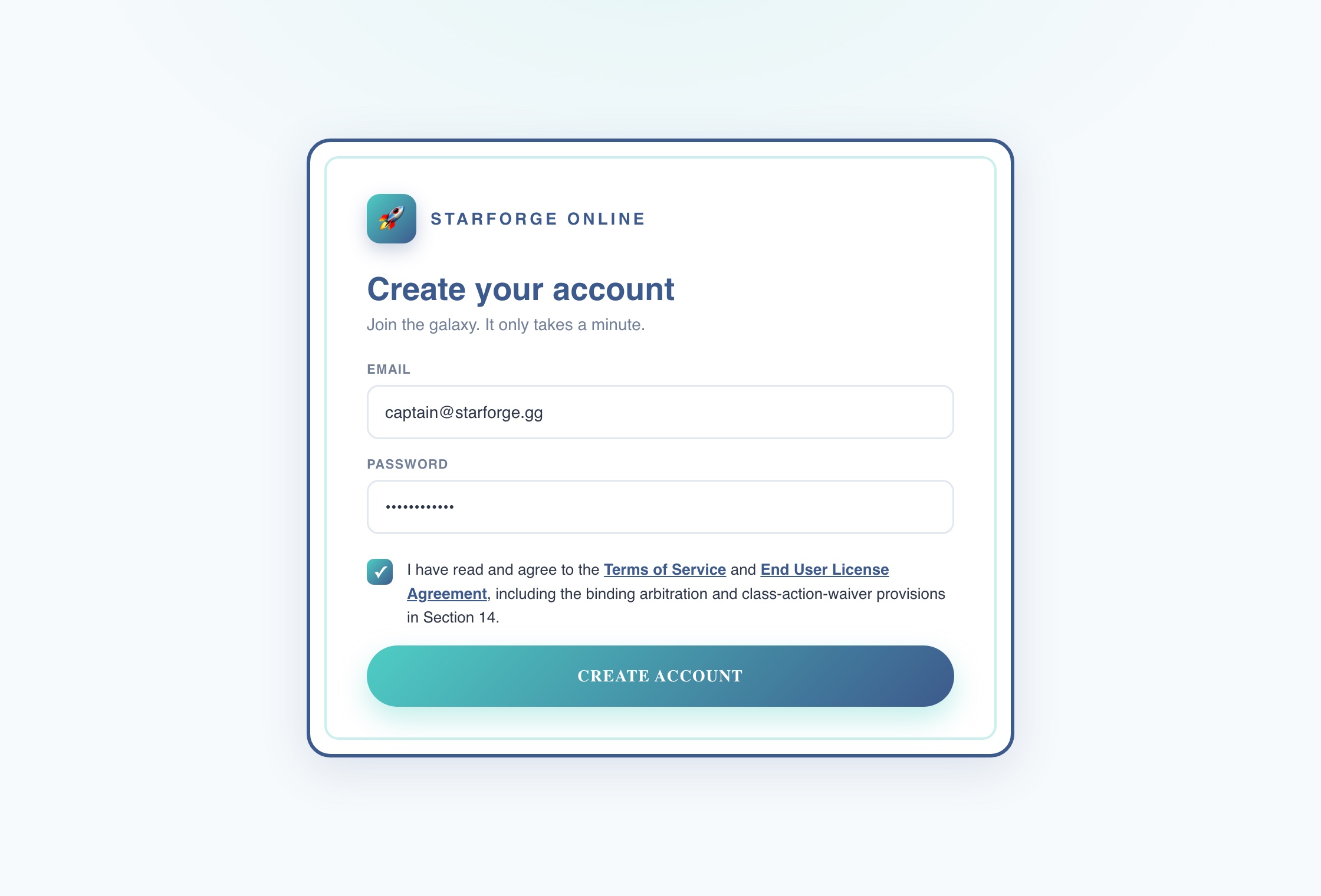
Clickwrap with a checkbox. The player cannot create an account without checking the box, and the box spells out exactly what they are agreeing to, including arbitration. This is the strongest, cleanest form of assent.
A sign-in wrap skips the checkbox but places a conspicuous notice right next to the button: “By clicking Create Account, you agree to our Terms of Service and EULA.” Courts enforce these too, as long as the notice is genuinely visible and tied to the action. The Second Circuit upheld exactly this kind of screen for Uber’s sign-up flow in Meyer v. Uber Technologies because the notice sat right above the button on a clean, uncluttered screen.
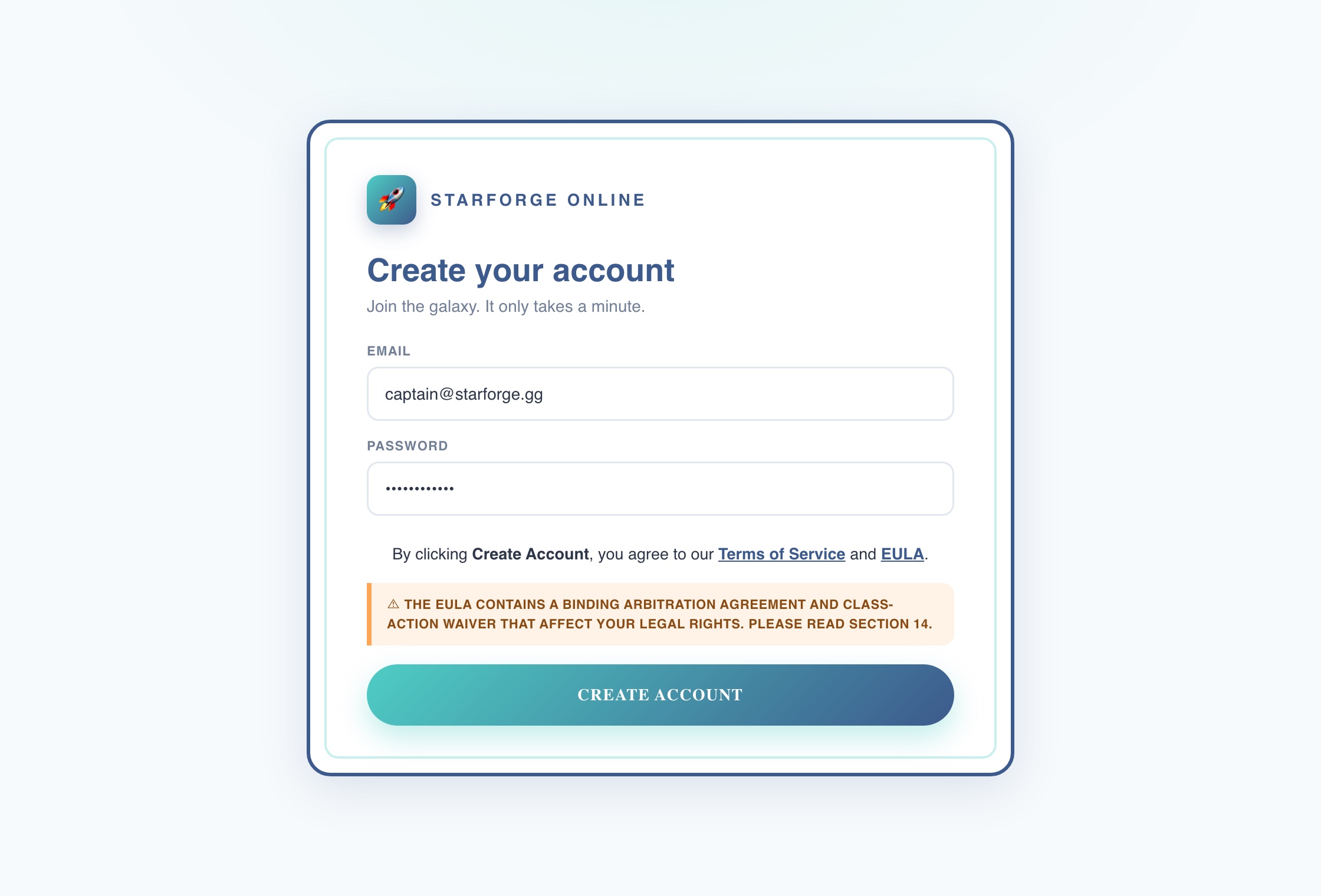
Sign-in wrap done right. No checkbox, but the notice sits directly on the button and an orange callout flags the arbitration clause. The player is clearly told that clicking means agreeing.
A browsewrap agreement just posts the terms behind a link, usually in a footer, and assumes the player agreed by using the game. This is where companies get burned. The player never takes any action that signals agreement, so there is no clear moment of assent. The Ninth Circuit rejected this approach in Nguyen v. Barnes & Noble, holding that a terms link near a button is not enough when the user is never required to do anything with it.
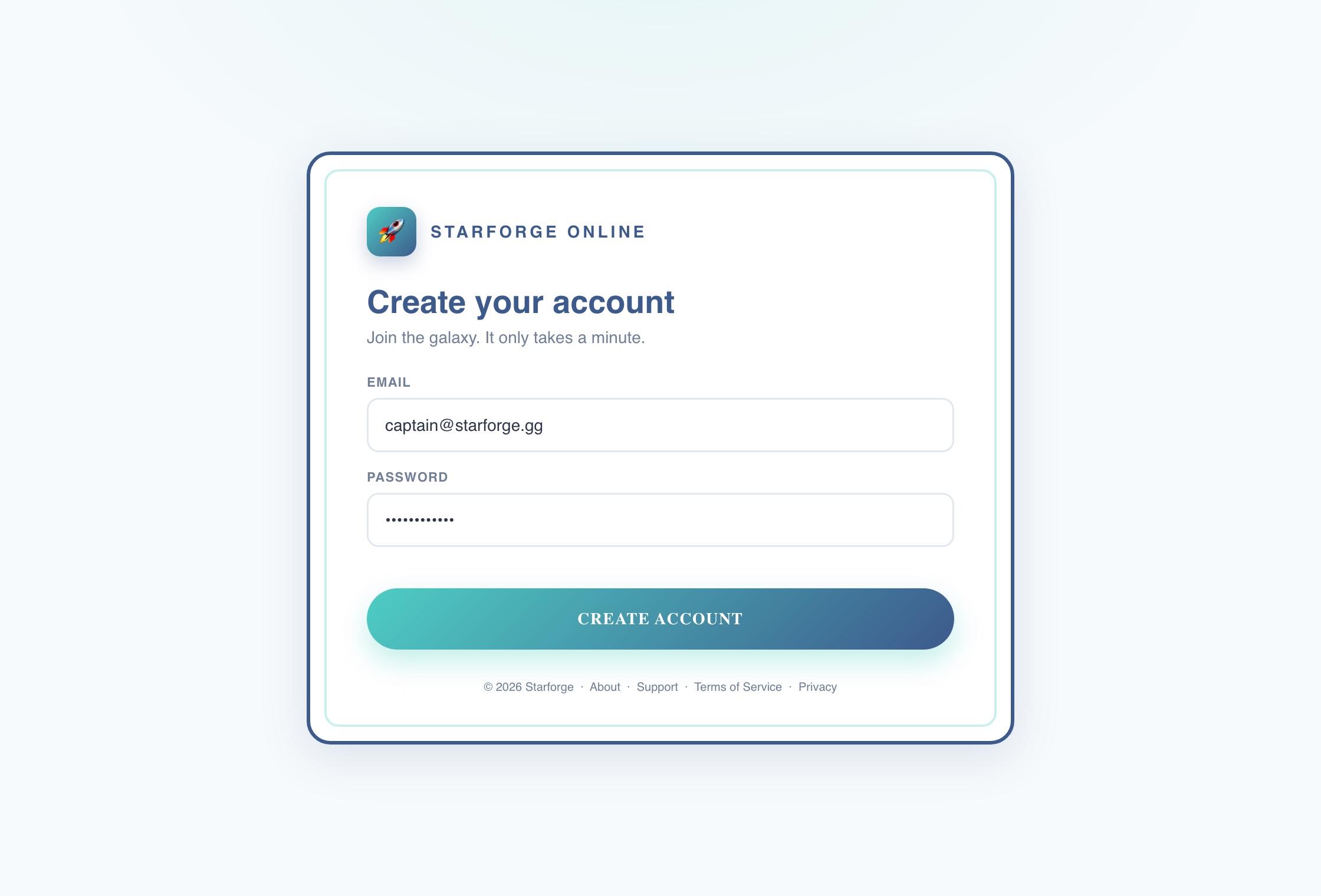
Browsewrap. The terms are buried in a footer link and the player is never asked to agree to anything. Courts routinely refuse to enforce terms presented this way.
What about shrinkwrap, and physical games?
You will sometimes see clickwrap and browsewrap grouped with an older term: shrinkwrap. Shrinkwrap comes from the boxed-software era, where the license was printed inside the packaging and opening the box or breaking the seal counted as acceptance. A federal appeals court blessed the idea in ProCD v. Zeidenberg, 86 F.3d 1447 (7th Cir. 1996), holding a buyer to license terms he could only read after he bought the box.
For a modern digital game, shrinkwrap is mostly a relic. Clickwrap has replaced it, and clickwrap is far stronger. But it still touches the physical side of the industry: a boxed PC release, a cartridge, a collector’s edition, and especially board games, where there is no launcher or account screen to host a clickwrap. If your only terms live inside the box, treat them as a weak backstop. Move anything that really matters, like arbitration, refunds, or IP ownership, to a point where the player has to click to agree.
What “done right” looks like, from our own industry
The best example comes straight from games. In B.D. v. Blizzard Entertainment, 76 Cal. App. 5th 931 (2022), a California appeals court enforced Blizzard’s EULA, arbitration clause and all, against a player who had spent real money on Overwatch loot boxes. The player was a minor. Blizzard still won on the contract question.
Why? The screen design. Blizzard’s sign-up flow showed the agreement in a pop-up, called out the arbitration section in plain, all-caps language so nobody could miss it, and put a “Continue” button directly under a line stating that clicking meant the player had read and understood the EULA. The player could not proceed without clicking, and Blizzard kept records showing that this player did.
That case is the clearest signal you will find: a well-built flow can bind even a minor player, at least far enough to force arbitration. The design carried the day.
The trend since then has only sharpened. In 2024 and 2025, the Ninth Circuit kept scrutinizing these screens closely, enforcing a mobile game’s sign-up flow in one case (Keebaugh v. Warner Bros.) while rejecting a subscription service’s terms in another where the notice was small, gray, and off to the side (Chabolla v. ClassPass). The pattern is consistent. Clean, conspicuous, action-tied design wins. Sloppy design loses.
Where game and board game companies get burned
The principle is easy. The places it breaks are specific to how we actually sell and ship games.
- Launcher and account sign-ups. This is your Blizzard moment. The register button is where the contract forms, or where it does not. Get this one screen right and a lot of downstream problems never happen.
- In-app purchases and loot boxes. The Blizzard case started with a player buying loot boxes. If your purchase and refund terms live only in an EULA the buyer never clicked through, enforcing them is hard, because you cannot show the buyer actually agreed.
- Crowdfunding backer terms. Kickstarter’s terms bind backers to Kickstarter. They do not bind backers to your separate fulfillment or refund policy. If your campaign page says “by backing you agree to our terms” with just a link and no click, that is browsewrap, and it is weak.
- Playtester and beta agreements. A checkbox and a click is fine. “Access implies agreement” behind a link is not. For closed betas and NDAs, use a real clickwrap.
- Minors. Games are full of them. A minor’s ability to back out of a contract is real, but it does not make your terms worthless. As Blizzard shows, a well-built flow can still bind a young player. Age-gating helps. It does not replace good design.
One more trap: updating your terms
Pushing a new EULA and assuming “they kept playing, so they agreed” is risky, especially when the new version adds something serious like a new arbitration clause. The player never saw the new terms and never agreed to them. If a change matters, resurface the agreement and get a fresh click the next time the player launches the game.
Want to handle this yourself, without hiring a lawyer?
Speedrun Legal is a 44-lesson course covering contracts, trademarks, copyright, LLCs, and publishing deals — built for indie devs on a budget. Includes a Contract Generator and AI publishing-deal review tool.
What you should do
Pull up your own sign-up, checkout, or install screen and run it against this short list:
- Put the terms notice right next to the button the player actually clicks.
- Make the button, or the line beside it, say out loud that clicking means agreeing.
- Make the link an obvious link, not tiny gray text tucked off to the side.
- Do not let the player get all the way through without clicking. The click is the assent.
- Call out the arbitration and class-action-waiver section clearly. I typically put a notice at the top of the EULA pointing the reader to where it lives in the document.
- Keep records of who agreed to which version, and when. Blizzard won partly because it could prove the click.
- For high-stakes terms, use a real checkbox. It removes any argument about whether the player agreed.
Deciding what clauses actually go inside that EULA is a separate question, and I wrote a full guide on the essential clauses in game EULAs. But none of those clauses matter if the player was never bound in the first place. Notice plus assent comes first. Everything else is downstream of a screen you can build correctly today.